
What is a quantity take-off?
Updated 13 November 2026
A quantity take-off is a list of every item on your plans, measured and counted in the unit it is bought and built in. It tells you how much of each thing the job needs, and once rates go against those quantities it becomes your estimate.
This guide covers what a take-off measures, how it differs from an estimate and a bill of quantities, how to check one is right, and what it costs to have one done for you.
What does a take-off measure?
Everything on the drawings that someone has to buy, deliver or build. Each item is measured in one unit and only one, so the number can go straight to a supplier or a subcontractor. These are the units you see most:
| Unit | What it means | What is measured in it |
|---|---|---|
| m² | Square metres | Slabs, walls, ceilings, roofing, tiling and paint |
| m³ | Cubic metres | Concrete, excavation and fill |
| m | Linear metres | Footings, skirtings, gutters, pipes and cable runs |
| No. | A count | Doors, windows, fixtures and fittings |
A wall is not one item. It is the frame, the lining on each side, the insulation, the skirting and the paint, each in its own unit. A good take-off breaks the job down that far, trade by trade, so nothing is counted twice and nothing is missed.
How is a take-off different from an estimate or a BOQ?
The three words get used for each other, but they are three steps of the same job:
- The take-off is the quantities: how many square metres, cubic metres, metres and items.
- The bill of quantities is those quantities set out item by item and trade by trade, with a rate and a total beside each line once it is priced.
- The estimate is the priced BOQ added up, with the exclusions and the open questions written beside it, ready for your margin.
A take-off on its own still leaves you to find a rate for every line. That is why ours comes priced. You get the quantities, the rates for your state and the totals in one Excel workbook. See what is in a priced bill of quantities for a real page from one.
How do you check a take-off is right?
You check it against the drawing. A list of numbers with nothing behind it asks you to trust it. A take-off with marked-up plans shows you where each number came from.
Marked-up plans. Follow each measured quantity back to the drawing. Every quantity in our BOQ is coloured on the plan it was measured off, so a number you doubt is one you can check in a minute. Wrong quantity? We fix it free.
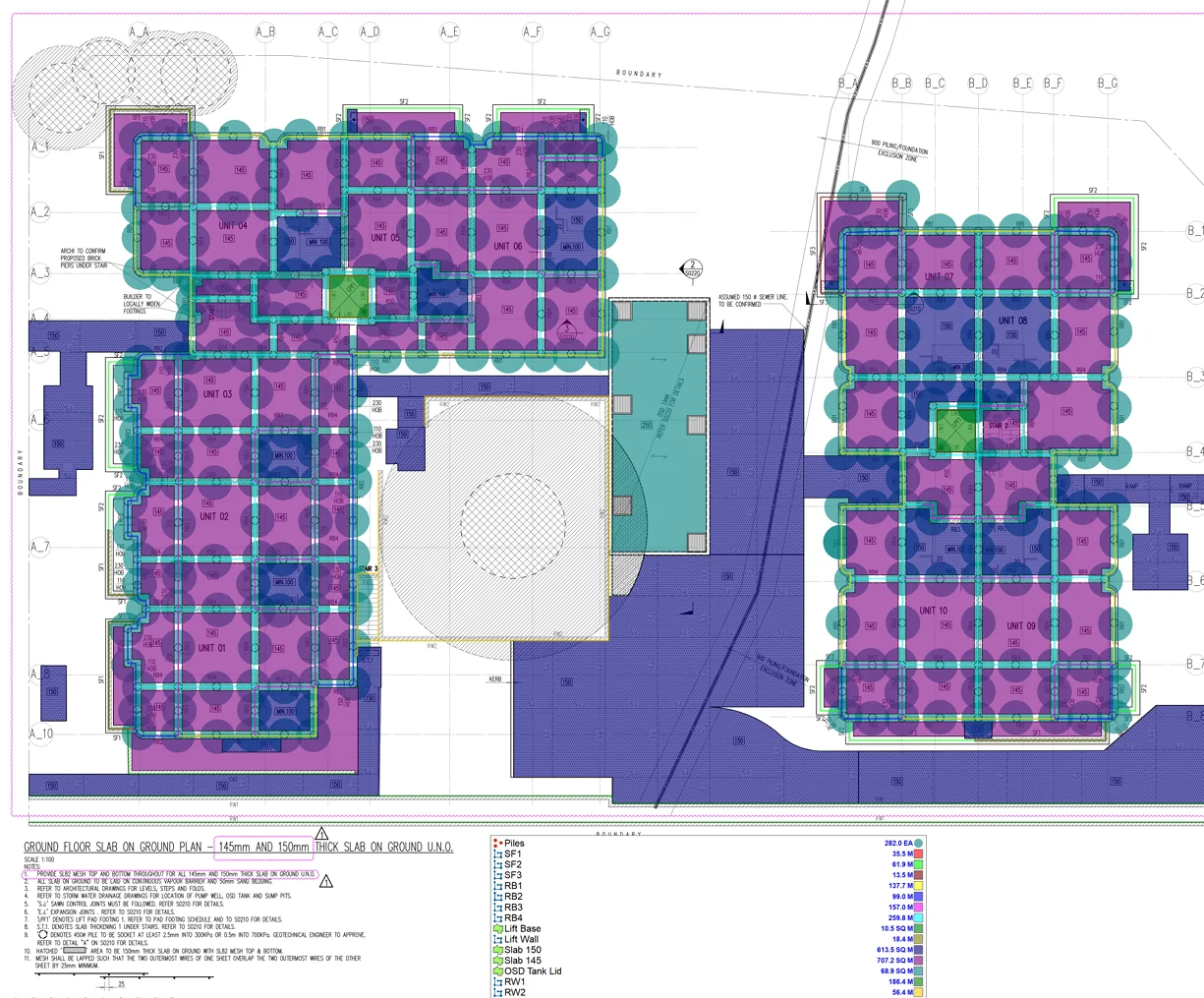
Three quick checks catch most problems. Pick the biggest line in each trade and find it on the plans. Look for an item you know is on the job, like a skylight or a set of stairs, and make sure it is in the list. Then read the exclusions list, because whatever is not measured should be written there.
Why would a builder pay for a take-off?
Because measuring is slow and it is not the part of the job that wins work. A builder who measures every set of plans at night has less time on site and fewer tenders out the door. A subcontractor pricing one trade still has to measure every wall it touches.
A Gold Coast painting contractor had 13 tenders priced in four months, $233 each on average. Read how Rusty's Painting used us for one trade.
Is a take-off done by hand or with software?
Most take-offs are now done on screen, measuring straight off PDF drawings rather than with a scale rule and a highlighter. The software counts and adds up, but a person still has to decide what each line is and what it includes.
At Constructline, AI assists the take-off and helps the team work through your drawings. Estimators apply the rates and resolve the detail, and Australian engineers check the estimate before it reaches you. People remain responsible for the finished work.
What do you need to send for a take-off?
Your plans, the job location and the date you need it back. The fuller the set, the fewer gaps. Send the structural drawings, the specification and any schedules you have. If a detail is missing, it goes on the RFI list as a question, or into the BOQ as a stated assumption you can see and change. Have your own supplier or subcontractor rates? Send those too.
What does a take-off cost?
Our fee starts at $200, ex GST, and it includes rates as well as quantities. A granny flat, renovation, extension or shed is $200 to $400. Larger jobs are worked out from the hours it takes to measure and price them, and you see one fixed fee before an estimator opens your plans. The guide to what a construction estimate costs shows the fees on real jobs.
Where do you go from here?
If you want the take-off done for you, the quantity take-off service page shows what comes back. If you are still deciding who should do it, read estimator vs quantity surveyor. More answers are in our guides.
Send us your plans